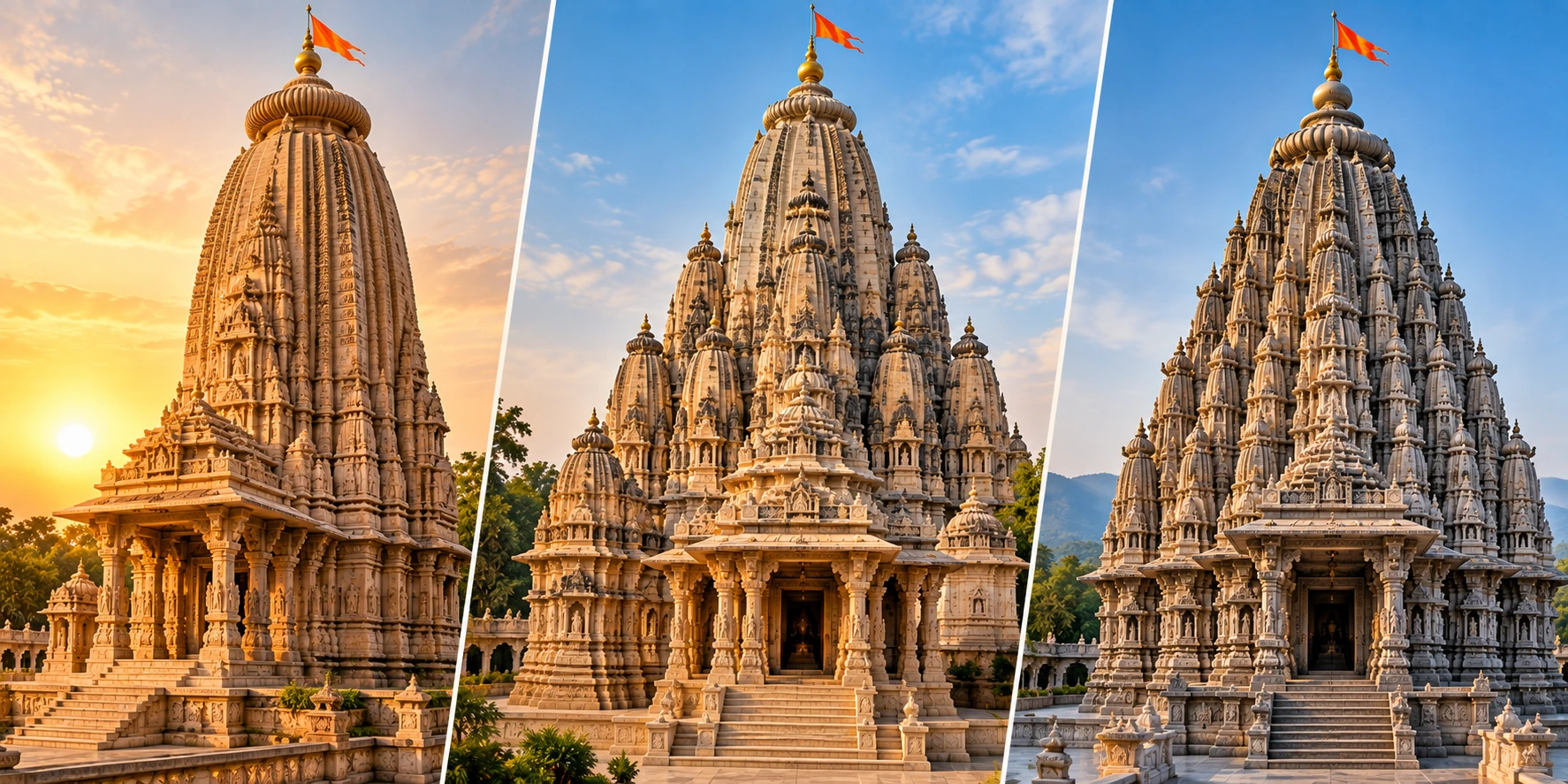
Nagara is the great temple architecture tradition of North and Central India, and the one most people picture when they think of a North Indian mandir. What distinguishes its different forms is mainly the shape of the tower above the sanctum. This guide explains the three main sub-styles, Latina, Shekhari and Bhumija, and how to think about which suits your project. Explore our Nagara style temple construction service.
What Defines a Nagara Temple?
- Raised platform: the temple usually stands on a plinth (jagati) that lifts it above the ground.
- Garbhagriha: the inner sanctum that houses the deity, with the Shikhara built above it.
- Mandapa: one or more halls in front of the sanctum, connected to it by a smaller antarala.
- Curvilinear Shikhara: a tower that curves gently inward as it rises, topped with an Amalaka and a Kalasha.
- Projecting wall planes: the plan is built up of vertical projections that carry through into the tower.
Latina: The Single Curvilinear Spire
Latina is the simplest and most fundamental form: one tower curving toward the top, with vertical bands that echo the projections of the plan. Many early North Indian temples, and the sanctum towers of Odisha, follow this basic idea. Its clean, unbroken profile gives a strong, focused silhouette.
Shekhari: A Spire Surrounded by Smaller Spires
The Shekhari form starts with the Latina tower and adds smaller half-spires attached to its sides, along with miniature spires at the corners. The result is a layered, mountain-like appearance. The temples of Khajuraho, such as the Kandariya Mahadeva temple, are well-known examples. Read more about our Shekhari temple construction.
Bhumija: A Grid of Miniature Shikharas
In the Bhumija form, the tower carries rows and columns of miniature shikharas arranged in a grid-like pattern, with a central projecting band running up the face. It is closely associated with the Malwa region of Madhya Pradesh, and the Udayeshvara temple near Vidisha is often cited as an example.
Which Sub-Style Suits Your Project?
- Site and scale: a compact plot may favour a simpler tower form.
- Carving and budget: layered forms need more carving work than a plain Latina tower.
- Region and tradition: local practice and the tradition your community follows may point to one form.
- Deity and shastra: your priest or advisor may have specific requirements.
The final design is always worked out against your site, your drawings and the shastric guidance you follow. To discuss it, request a free consultation or see our temple construction in Bhopal.