
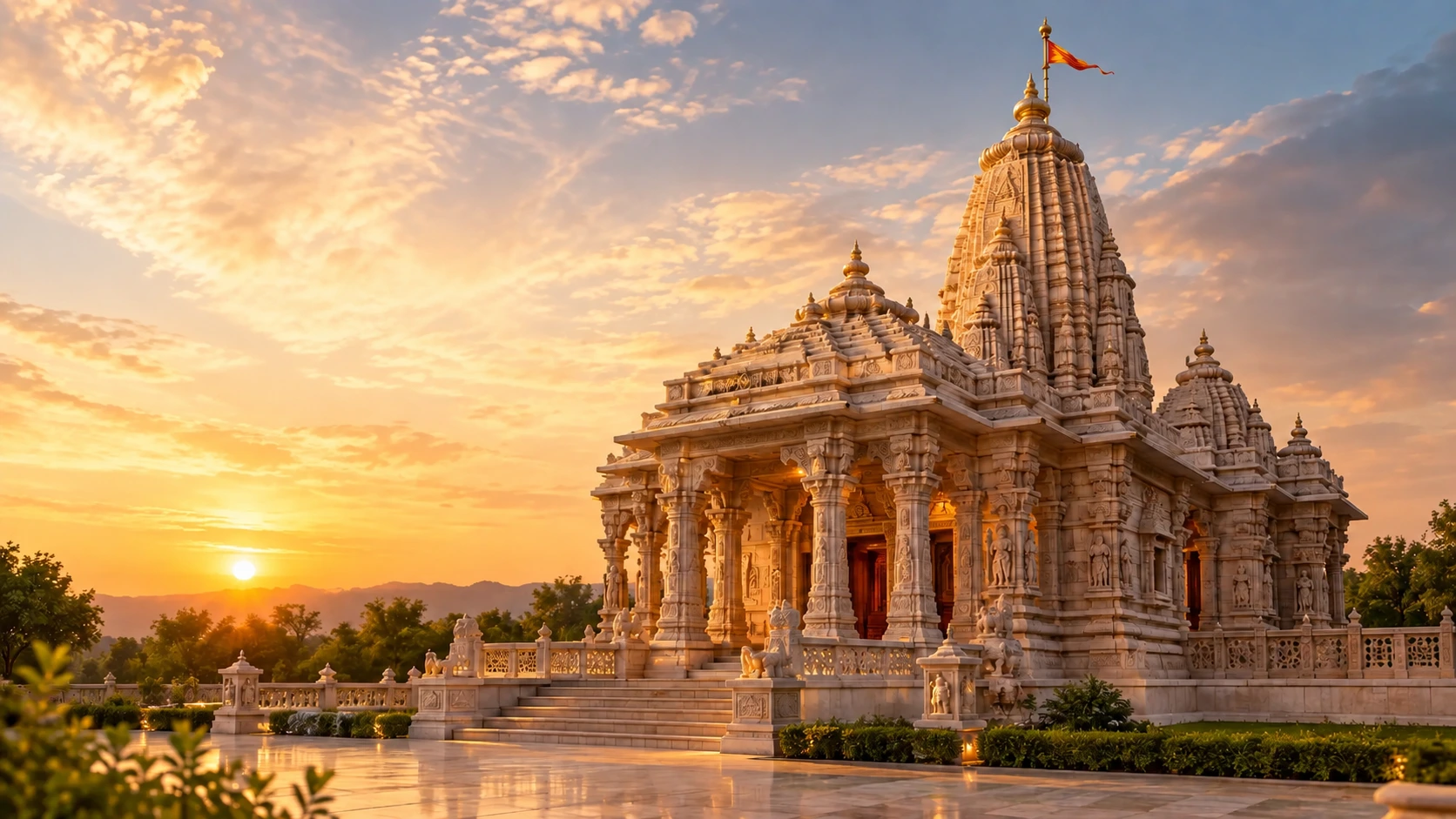
The dominant temple architecture tradition of North India, defined by a curvilinear Shikhara tower rising in a single sweeping arc above the Garbhagriha, typically without the surrounding boundary wall seen in Dravidian temples.
Nagara style is identifiable by its beehive-shaped or curvilinear Shikhara, usually capped with an Amalaka (ribbed stone disc) and Kalash. The style developed across several regional schools — Odisha, Khajuraho's Chandela tradition, and the Solanki temples of Gujarat — each adding its own variation while keeping the core curvilinear tower form.
As the most common style requested by clients across Bhopal and Madhya Pradesh, we have deep, repeated experience translating Nagara proportions correctly using the Talamana measurement system, ensuring the Shikhara curve and Amalaka placement match classical references rather than a generic approximation.
Key structural and ornamental characteristics of Nagara Style architecture.
The defining silhouette of Nagara Style temples, engineered correctly for load distribution and carved with traditional ornamentation.
Material selection follows the original regional tradition where possible, balanced against availability and budget in Madhya Pradesh.
We can execute the major variants within this tradition: Odisha (Kalinga), Khajuraho (Chandela), Solanki (Gujarat), Latina (single tower), matched to your community's specific reference temple.
Nagara is not a single fixed design, but a family of related regional traditions sharing a curvilinear Shikhara.
The Odisha school, also called Kalinga, is known for its especially vertical, beehive-shaped towers and its clear separation between the sanctum tower and the assembly hall. The Khajuraho or Chandela tradition, closer to home in Madhya Pradesh, is known for its Shekhari clustering of smaller spires around the central tower and its dense figural carving. The Solanki temples of Gujarat contribute a distinct treatment of the Shikhara's surface projections and stepped platforms. When a client asks for "Nagara style" without specifying further, we discuss which of these regional references they have in mind, since the resulting temples look meaningfully different from each other despite sharing the same basic curvilinear tower principle.
The visual character of a Nagara Shikhara depends heavily on the exact rate at which its profile curves inward as it rises, a detail that is easy to get subtly wrong without careful reference to the Talamana measurement system. Because Nagara is the style most frequently requested by our Madhya Pradesh clients, we have built up repeated, direct experience translating these proportions correctly, checking the Shikhara curve and Amalaka placement against classical references rather than approximating the silhouette by eye.
Talk to our Vastu and architecture team about adapting this tradition to your site in Madhya Pradesh.
Explore other temple construction services that often go hand-in-hand with this one.
Shikhara Temple Construction by specialist shilpakars, fully Vastu and Agama Shastra compliant.
Shekhari Temple Construction by specialist shilpakars, fully Vastu and Agama Shastra compliant.
Kalinga Temple Construction by specialist shilpakars, fully Vastu and Agama Shastra compliant.
Common questions about nagara Style Temple Construction.
The dominant temple architecture tradition of North India, defined by a curvilinear Shikhara tower rising in a single sweeping arc above the Garbhagriha, typically without the surrounding boundary wall seen in Dravidian temples.
Yes. While Nagara style originated in North India, the structural and Vastu principles travel — we adapt material sourcing and craftsmanship to build authentic Nagara Style temples anywhere in Madhya Pradesh.
Yes, Nagara style and its variants are the most frequently requested architecture across our Madhya Pradesh projects, given the region's proximity to classical Nagara sites like Khajuraho.
We base the recommendation on your community's tradition, the deity being installed, site dimensions and budget, discussed in detail during the initial Vastu consultation.
Temple construction guides, material comparisons, Vastu Shastra articles and project case studies, directly in your inbox.