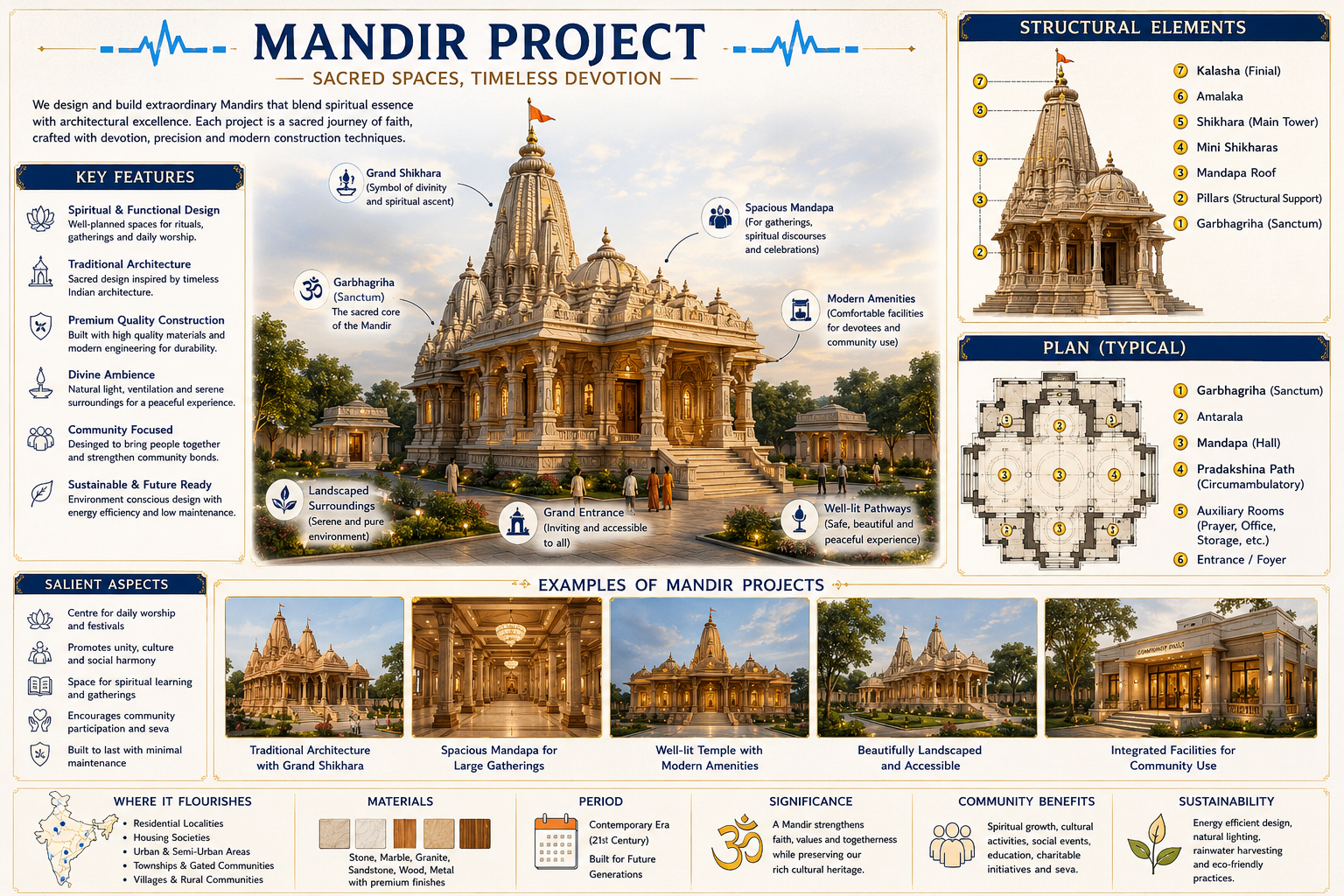
Temples Constructed
A Vesara sub-style developed under the Hoysala dynasty, famous for star-shaped (stellate) ground plans and extraordinarily intricate soapstone carving covering nearly every surface of the temple, as seen at Belur and Halebidu.
Hoysala architecture is the most ornamentally dense tradition we offer — friezes of elephants, horses, deities and floral motifs typically wrap continuous bands around the temple's lower walls, all executed in soapstone (chloritic schist), a material that carves with exceptional fineness when freshly quarried and hardens over time.
Given the carving intensity, Hoysala-style projects are generally reserved for clients with a strong heritage connection to Karnataka or a specific desire for this level of ornamental detail, and require an extended timeline compared to simpler styles.
Key structural and ornamental characteristics of Hoysala architecture.
The defining silhouette of Hoysala temples, engineered correctly for load distribution and carved with traditional ornamentation.
Material selection follows the original regional tradition where possible, balanced against availability and budget in Madhya Pradesh.
We can execute the major variants within this tradition: Stellate (star-shaped) plan, Friezed wall bands, Lathe-turned pillars, matched to your community's specific reference temple.
Explore other temple construction services that often go hand-in-hand with this one.
Vesara Style Temple Construction by specialist shilpakars, fully Vastu and Agama Shastra compliant.
Dravidian Style Temple Construction by specialist shilpakars, fully Vastu and Agama Shastra compliant.
Maru-Gurjara Temple Construction by specialist shilpakars, fully Vastu and Agama Shastra compliant.
Common questions about hoysala Temple Construction.
A Vesara sub-style developed under the Hoysala dynasty, famous for star-shaped (stellate) ground plans and extraordinarily intricate soapstone carving covering nearly every surface of the temple, as seen at Belur and Halebidu.
Yes. While Hoysala style originated in Karnataka, the structural and Vastu principles travel — we adapt material sourcing and craftsmanship to build authentic Hoysala temples anywhere in Madhya Pradesh.
Traditional Hoysala temples were built in soapstone (chloritic schist), which carves finely when freshly quarried. We can source comparable soapstone or recommend an alternative fine-grained stone depending on availability and budget.
We base the recommendation on your community's tradition, the deity being installed, site dimensions and budget, discussed in detail during the initial Vastu consultation.