
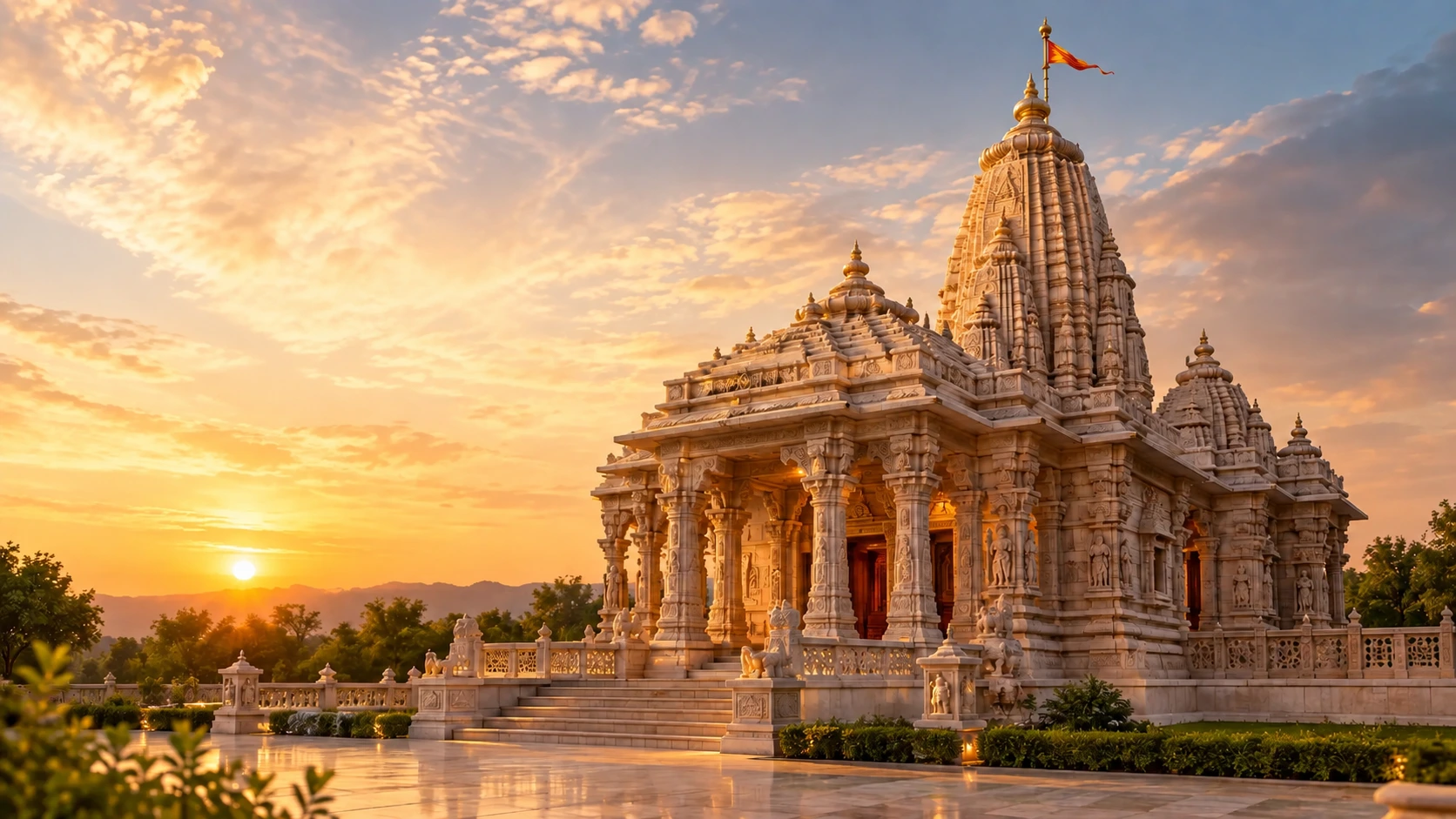
Temples defined and named for their prominent Shikhara tower — the curvilinear superstructure rising directly above the Garbhagriha, the single most recognisable element of North Indian temple architecture.
While 'Shikhara' technically refers to the tower itself rather than a complete style, many clients use the term to describe the broader family of temples where the tower dominates the architectural composition — typically Nagara-derived structures with a strong vertical emphasis and minimal lower-level ornamentation by comparison to the tower.
We approach Shikhara-led temple design by getting the tower's proportions and curve right first using Talamana calculations, then designing the Garbhagriha, Mandapa and entrance to complement rather than compete with that vertical emphasis.
Key structural and ornamental characteristics of Shikhara architecture.
The defining silhouette of Shikhara temples, engineered correctly for load distribution and carved with traditional ornamentation.
Material selection follows the original regional tradition where possible, balanced against availability and budget in Madhya Pradesh.
We can execute the major variants within this tradition: Latina (single curve), Shekhari (clustered), Bhumija (lattice tiers), Valabhi (barrel-vaulted), matched to your community's specific reference temple.
Strictly, Shikhara refers to the tower element itself, not a complete architectural style.
In everyday conversation, many clients use "Shikhara style" to describe the broader family of temples where the tower dominates the composition, typically Nagara-derived structures with a strong vertical emphasis and comparatively minimal lower-storey articulation. We take this description at face value during consultations, since it correctly signals a design priority, a temple that reads first and foremost as a tower, even though it isn't a formal style category on its own.
Within this family, the specific sub-style matters for how the tower is detailed: Latina gives a single, unbroken curve; Shekhari clusters smaller spires around the main tower; Bhumija arranges the surface in a grid-like lattice of miniature tiers; and Valabhi uses a distinct barrel-vaulted profile associated with certain regional traditions.
Our approach is to fix the tower's proportions and curve first, using Talamana calculations, before designing the Garbhagriha, Mandapa and entrance beneath it. This ordering matters because a Mandapa or entrance designed independently, then paired with a dominant tower afterward, often competes with the tower visually instead of supporting it; resolving the tower's geometry first lets everything below it be scaled to complement rather than distract from the vertical emphasis the client is asking for.
Talk to our Vastu and architecture team about adapting this tradition to your site in Madhya Pradesh.
Explore other temple construction services that often go hand-in-hand with this one.
Nagara Style Temple Construction by specialist shilpakars, fully Vastu and Agama Shastra compliant.
Specialised Shikhara and Vimana construction in Latina, Shekhari and Vesara styles by trained shilpakars.
Shekhari Temple Construction by specialist shilpakars, fully Vastu and Agama Shastra compliant.
Common questions about shikhara Temple Construction.
Temples defined and named for their prominent Shikhara tower — the curvilinear superstructure rising directly above the Garbhagriha, the single most recognisable element of North Indian temple architecture.
Yes. While Shikhara style originated in North India, the structural and Vastu principles travel — we adapt material sourcing and craftsmanship to build authentic Shikhara temples anywhere in Madhya Pradesh.
They overlap significantly — Shikhara is the defining tower element of Nagara architecture. We use 'Shikhara style' to describe projects where the client wants the tower to be the clear visual focus of the temple.
We base the recommendation on your community's tradition, the deity being installed, site dimensions and budget, discussed in detail during the initial Vastu consultation.
Temple construction guides, material comparisons, Vastu Shastra articles and project case studies, directly in your inbox.