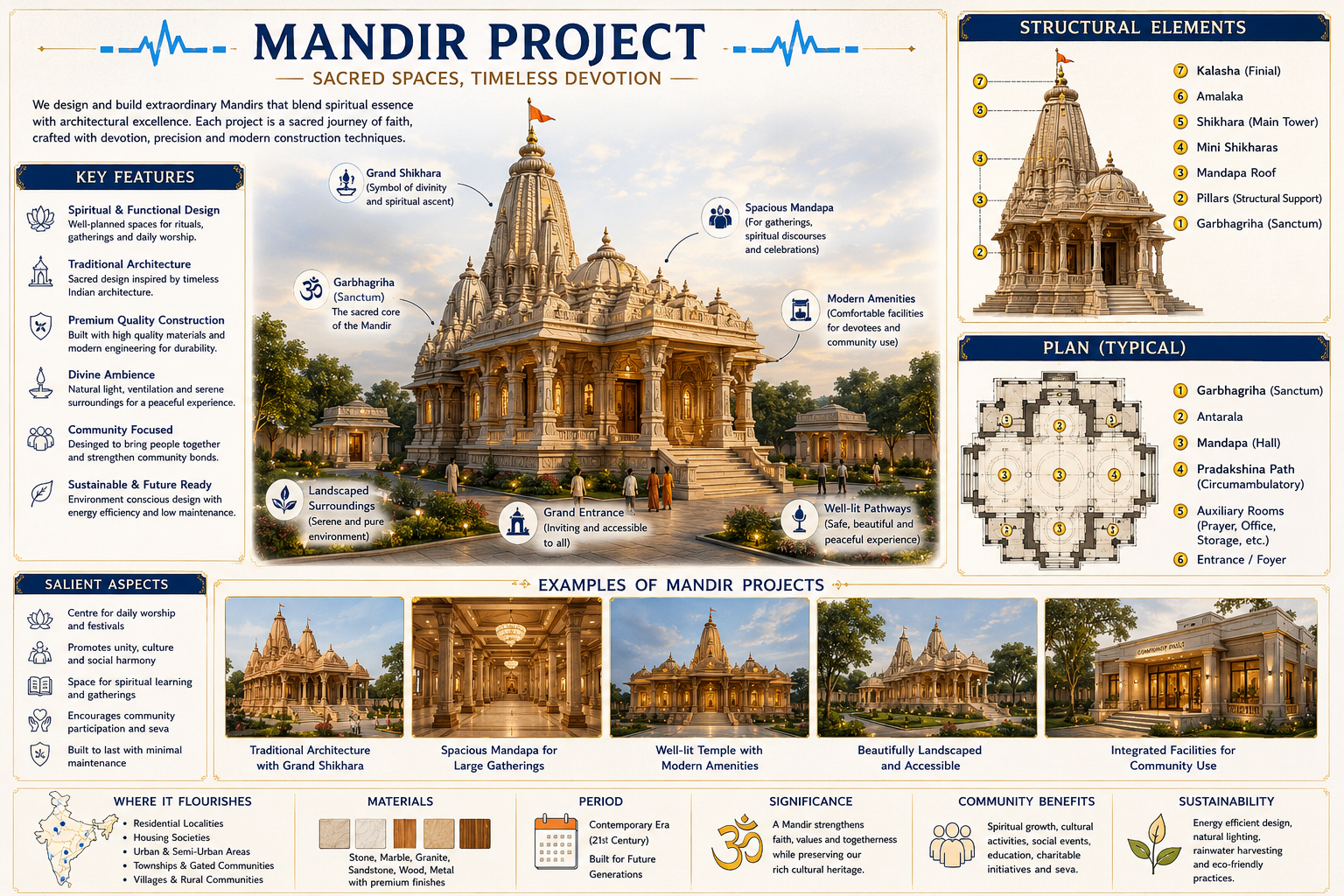
Temples Constructed
For community groups and local trusts who want a public or community-owned plot serving an entire neighbourhood, we bring the same Nagara-style discipline used in our full temple projects — scaled and adapted appropriately.
Nagara architecture is defined by a curvilinear Shikhara tower rising in a single sweeping arc above the Garbhagriha. When this style is applied to a community temple, we adapt the proportions and Talamana calculations to fit a public or community-owned plot serving an entire neighbourhood, without compromising the Vastu Shastra orientation principles that govern the original tradition.
Material selection typically draws on Bansi Paharpur sandstone and marble, balanced against the scale and budget appropriate for community groups and local trusts. The result is a temple that genuinely reads as Nagara architecture — not a generic structure with decorative motifs added on — sized correctly for collective devotion and social bonding.
A community temple project built to genuine Nagara architectural standards.
Shikhara and Garbhagriha proportions calculated using the Talamana system specific to Nagara architecture, scaled correctly for a community project.
Designed specifically around a public or community-owned plot serving an entire neighbourhood, balancing Nagara authenticity with the practical needs of community groups and local trusts.
Constructed primarily in Bansi Paharpur sandstone and marble, the traditional material palette for Nagara temples, selected for durability and budget fit.
Explore other temple construction services that often go hand-in-hand with this one.
Modern temple construction in authentic Nagara style, built in Bansi Paharpur sandstone and marble.
Apartment Complex temple construction in authentic Nagara style, built in Bansi Paharpur sandstone and marble.
Nagara Style Temple Construction by specialist shilpakars, fully Vastu and Agama Shastra compliant.
Common questions about community Temple in Nagara Style.
Yes. Nagara architecture's defining features — a curvilinear Shikhara tower rising in a single sweeping arc above the Garbhagriha — scale down (or up) correctly using Talamana proportioning, so a community project stays authentic to the style rather than becoming a generic structure with decorative add-ons.
We primarily use Bansi Paharpur sandstone and marble, the traditional material palette for Nagara temples, selected and finished appropriately for the scale of a community project.
Timeline depends on scale and carving detail. A compact community project in Nagara style typically takes a few weeks to a few months; larger community projects can take longer — we confirm an exact schedule after the site visit.
Yes, every project — regardless of style or type — begins with a Vastu Shastra site assessment covering orientation, proportions and deity placement.